
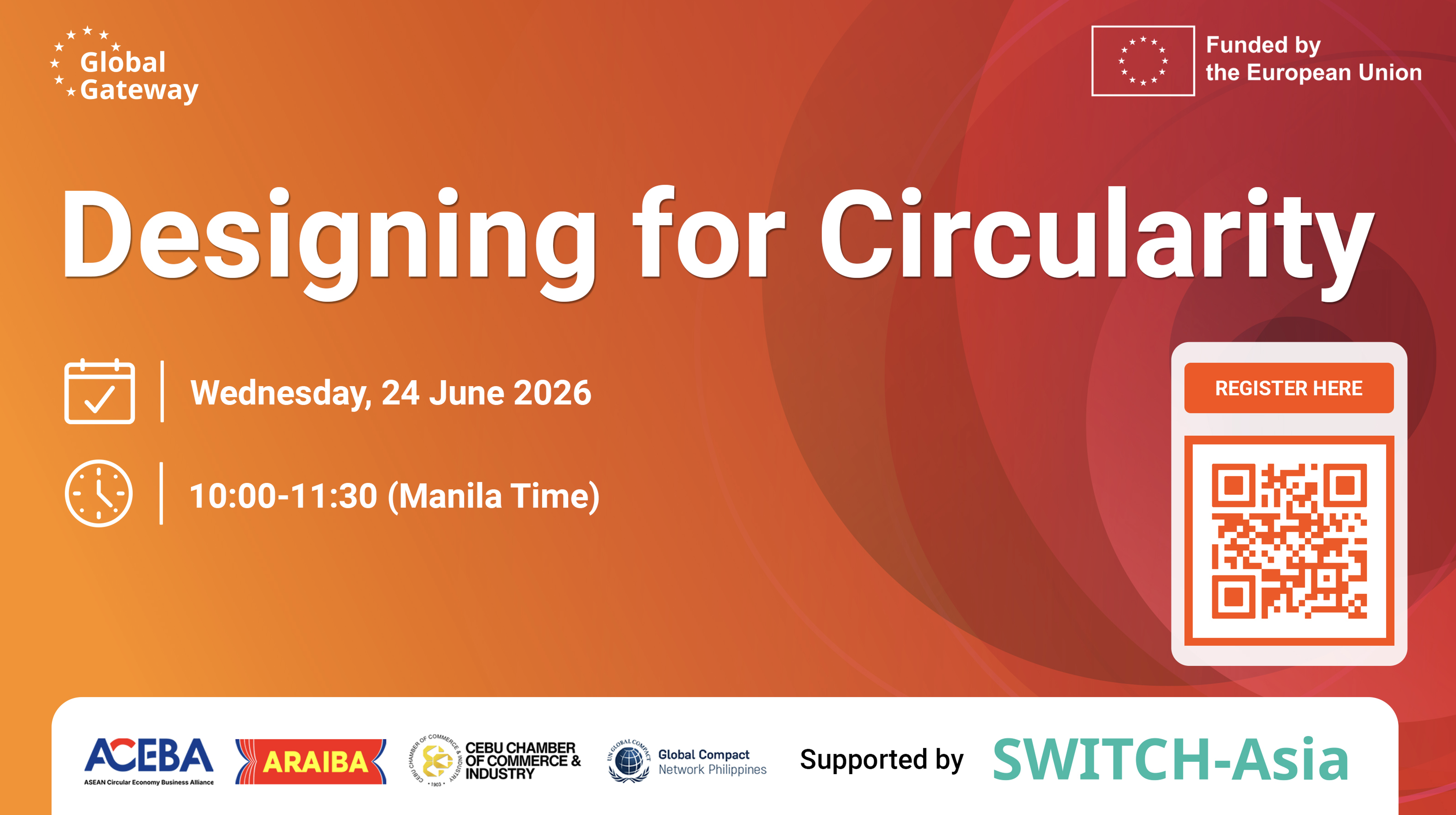
ACEBA PH Circular Business Webinar Series: Designing for Circularity
Background
The ASEAN Circular Economy Business Alliance (ACEBA) was launched in 2024 to further facilitate business leadership and action on Circular Economy, in support of Philippine and regional policies, plans, and strategies. ACEBA engages businesses through advocacy, knowledge and experience sharing, capacity building, and networking. Key partners in the Philippines are the Cebu Chamber of Commerce and Industry (CCCI), one of the oldest chambers of commerce in the country and is the ACEBA country lead for the Philippines, and Global Compact Network Philippines, the national network of the United Nations Global Compact that brings together Philippine companies and non-business stakeholders who have committed to uphold and operationalize the Ten Principles of the UNGC (foundational business responsibilities in the areas of human rights, labour, environment, and anti-corruption).
This year, ACEBA, CCCI, and GCNP are co-hosting this Circular Business Webinar Series to deepen understanding of the circular economy, and facilitate circular business learning—design, development, implementation, and assessment—among Philippine businesses, including start-ups and Micro, Small, and Medium Enterprises (MSMEs). Each webinar/ session in this series is envisioned to generate business interest, ideas, and action plans for circular business innovation, design, and implementation.
Making Circular Economy work for your business
Circular Economy takes a systems view on the use and disposal of materials and other natural resources in the economy and society, to bring both the net inflows and net outflows of materials and other natural resources as close as possible to zero[1]. For business, this involves taking responsibility to minimize impacts on the environment of the use and disposal of materials, energy, water, and possibly other natural resources, in its products, services, and business operations, taking a life cycle perspective. This also requires innovation in products, services, and processes towards circular value chains, that use materials and other natural resources in closed loops efficiently, and for extended use periods, while also capturing the benefits of renewable materials and energy.
Beyond the necessity to tackle the interrelated climate, nature and pollution crises, the Circular Economy provides a solid platform for businesses to perform well – through cost savings, new business opportunities, and improved resilience and preparedness – and do good – for people and the planet. The practical business value of Circular Economy is evident in a number of business cases from the Philippines and other countries in the region.
Embedding circularity in business products and systems
The operationalization of Circular Economy, however, requires tailored approaches considering a business’ specific operating environment; its products, services, and business processes; the value chains it is part of; and its maturity in understanding and committing to Circular Economy.
Critical to this is embedding circularity in the design of products and systems. Design is the critical process in which environmental impacts can be minimized to achieve sustainability goals, and to achieve circularity through design, the design of products and systems must be re-examined. With 80% of environmental impacts determined in the design stage, a product’s design becomes paramount in enabling product and/or material circularity[2]. Transitioning to a circular economy requires taking appropriate, radical approaches to the design process.
ACEBA PH Circular Business Webinar Series: DESIGNING FOR CIRCULARITY
The second session of this webinar series will tackle circular design as an approach to business product and systems development. While models may vary, core circular economy design principles include: designing out waste and pollution, keeping products and materials in use, designing for disassembly, using regenerative materials, optimizing resource efficiency, and enabling closed-loop systems.
The webinar will be informed by selected circular business practices and models in ASEAN, particularly in the Philippines, as curated by ACEBA and the EU SWITCH-Asia Policy Support Component from 2023-2025. Guest speakers will also talk about pioneering efforts and business models highlighting circular design.
The webinar will be interactive, and participants will be engaged in Q&A or short reflections.
Target Participants. This webinar is designed to engage business and industry professionals involved in business management, operations, product and business development, environment and sustainability, research and innovation, and related areas. The session is not sector-specific, and will cover circular design principles, perspectives, and ideas applicable to a wide range of sectors and industries.
WEBINAR AGENDA/PROGRAM
|
TIME |
ACTIVITY |
|
10:00 – 10:05AM |
Opening and webinar overview |
|
10:05 – 10:15 |
Welcome remarks (3 minutes each) Mr. Thomas Thomas Co-convenor, ACEBA; Chair, ARAIBA Sdn Bhd Mr. Regan Rex King President, Cebu Chamber of Commerce and Industry Mr. Ben Secretario Interim Executive Director, Global Compact Network Philippines
|
|
10:15 – 10:35 |
Circular Design: Principles, approaches, and business applications Dr. Rene Van Berkel Co-convenor, ACEBA; Senior Expert, EU SWITCH-Asia Policy Support Component
|
|
10:35 – 11:10 |
PANEL: Circular products and business models Ms. Rolyn Lomocso Senior Researcher, Materials Research and Development Program Design Center of the Philippines Mr. Matthew Lazaro Vice President, Asia Textile Mills Inc. Dr. Thanyaporn Krichtitayawuth Executive Director, Global Compact Network Thailand (GCNT) PANEL MODERATOR: Mr. Gil Gonzales Co-convenor, ACEBA
|
|
11:10 – 11:25 |
Q&A with participants |
|
11:25 – 11:30 |
Closing |
[1] https://www.aceba.co/resource/circular-economy-an-introduction-and-overview/
[2] Tan, Esmonde SH, et.al. Design for Circularity: A Framework for Sustainable Product Redesign. Procedia CIRP,
Volume 122, 2024, pp. 479-484. ISSN 2212-8271. https://www.sciencedirect.com/science/article/pii/S2212827124000921
Share: