
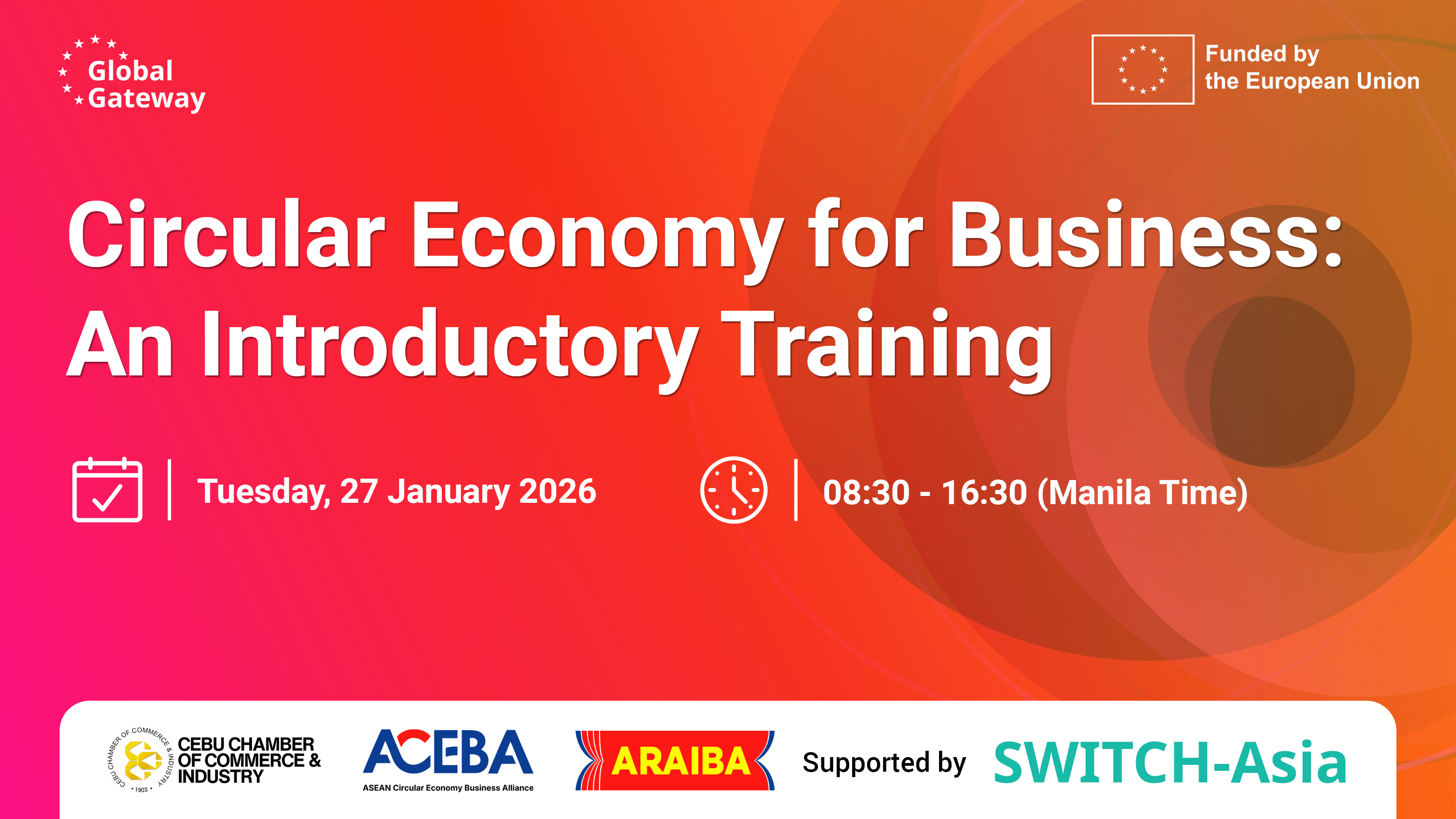
Circular Economy for Business: An Introductory Training
Background
Southeast Asia has committed to transition to the Circular Economy to support resilient economies, sustainable growth, and resource efficiency, through the 2021 ASEAN Circular Economy Framework. This is complemented by national policy and action plans in ASEAN Member States, including in the Philippines. The country has adopted a Philippine Action Plan for Sustainable Consumption and Production, enacted the Extended Producer Responsibility Act in 2022, and implemented sustainable public procurement initiatives.
Leading businesses and other organisations in the Philippines and in the region have started to benefit from the adoption of Circular Economy practices in sectors as diverse as hospitality, building materials, agri-food, textiles, and recycling and resource recovery.
The ASEAN Circular Economy Business Alliance (ACEBA) was launched in July 2024 to further facilitate business leadership and action on Circular Economy, in support of stated Philippine and regional policy objectives. ACEBA engages businesses through advocacy, knowledge and experience sharing, provision of actionable tools and insights, and networking. The Cebu Chamber of Commerce and Industry (CCCI) has assumed the role of country lead for ACEBA in the Philippines.
This business training co-hosted by ACEBA and CCCI, with support from the EU SWITCH Asia Policy Support Component (PSC) , will provide a comprehensive introduction and overview of Circular Economy for business, and zoom in on practical ways to turn the Circular Economy ambition into practice to the advantage of business, whilst reducing impacts on environment and society.
Circular Economy: A Responsible Business and Innovation Opportunity
Circular economy takes a systems view on the use and disposal of materials and other natural resources in the economy and society, to bring both the net inflows and net outflows of materials and other natural resources as close as possible to zero. For business, this involves taking responsibility to minimize impacts on the environment of the use and disposal of materials, energy, water, and possibly other natural resources in its products, services, and business operations, taking a life cycle perspective. This requires innovation in products, services, and processes towards circular value chains, that use materials and other natural resources in closed loops efficiently, and for extended use periods, whilst also capturing the benefits of renewable materials and energy.
Beyond the necessity to tackle the interrelated climate, nature and pollution crises, the Circular Economy provides a solid platform for businesses to perform well –through cost savings, new business opportunities, and improved resilience and preparedness – and do good – for the planet and people. The practical business value of Circular Economy is evident in business cases from the Philippines and other countries in the region.
Making Circular Economy Work for Your Business
Circular Economy is, principally, relevant to any business—regardless of size, age, sector, location, market, and ownership structure. The operationalization of Circular Economy, however, requires tailored approaches considering the business’ specific operating environment; the value chains it is part of; and its maturity in understanding and commitment to Circular Economy.
Recognising there is no one-size-fits-all roadmap for the successful adoption of Circular Economy, ACEBA developed a flexible framework of circularity-enabling functions and capabilities to support businesses to deliver impactful circularity results for their business, and for society and the environment. This covers four activity clusters:
1. Stocktake: Scoping of Circular Economy opportunities and risks, following a materiality assessment of circularity issues in the business environment, and the value chains the business is part of;
2. Ambition: Clarification of relevant circularity ambitions for operations, products and services, inputs and outputs, and key delivery pathways for improvement and innovation;
3. Delivery: Implementation of circular solutions in operations, products and services, inputs and outputs through adaptation of good practices and best techniques demonstrated elsewhere, and/or the pivoting into innovative circular solutions; and
4. Integration: Mainstreaming circularity in business processes, management systems and business models and organization.
This SADI Framework provides a menu for business to conceptualize, steer, and plan circularity initiatives for its products and services, business processes and activities, and the value chains and networks it is part of.
Training objectives, methods and target participants
This one-day training programme for business and industry professionals will:
1. Provide a comprehensive introduction and overview of Circular Economy for business, including its rationale, concepts and practical applications in businesses in Philippines and elsewhere in Southeast Asia;
2. Familiarize and practice key design strategies for circular products, business processes and business models; and
3. Introduce the SADI activity menu for implementation of Circular Economy in enterprises.
The training is informed and inspired by the Circular Economy business practices and achievements in Southeast Asia, as curated by ACEBA with the support of SWITCH-Asia Policy Support Component during 2023-25.
Training Methods: This training will be interactive. Apart from speaker presentations, participants will be engaged in Q&A, hands-on group work, breakout sessions, and reflection.
Targeted Participants: The training is designed to engage mid-to-senior level business and industry professionals with experience in operations, product and business development, environment and sustainability, research and innovation, or related areas. The training is not sector-specific, and will cover opportunities and challenges for Circular Economy in different sectors such as agri-food, textile and garment, plastics and packaging, hospitality, and building and construction.
Training resource/ reference material: Primary resource for this training is the ACEBA guidebook on “Unlocking the Circularity Opportunity: Guidance to Advance Circular Business”. Participants are advised to download this guidebook in advance/ in preparation for the training.
Speakers/ Facilitators
The training will be led and guided by ACEBA’s co-convenors:
Mr. Thomas Thomas. Founder and Chairman of ARAIBA Sdn Bhd, the successor organisation to ASEAN CSR Network (ACN), of which he was the founder and CEO. He has been involved in responsible business, CSR, and sustainability since 2004, when he co-chaired Singapore’s National Tripartite on CSR, and set the direction for business responsibility in Singapore as founder of the Singapore Compact for CSR. Thomas is also the Chair of the ISO26000 Stakeholder Global Network (SGN) since 2022. He has been active with trade unions, co-operatives, the consumer movement, and social enterprises, and also served as a Nominated Member of Parliament in Singapore. Thomas holds a Master of Arts in Industrial Relations from Warwick University, UK.
Dr. Rene Van Berkel. A leading expert in circular economy, resource efficiency, and responsible business practice. Since 2023, he is an international expert, contributing amongst others, to the EU SWITCH Asia Policy Support Component, and international faculty at the School of Global Studies, Thammasat University, Thailand. His 35-year career covers more than 15 years in leadership roles at the United Nations Industrial Development Organization (UNIDO) in India, Indonesia, and at Headquarters in Austria, and senior academic roles at Curtin University of Technology, Australia, and University of Amsterdam, The Netherlands. Dr. Van Berkel holds a PhD in Environmental Science of the University of Amsterdam, and a Master’s in Environmental Hygiene from Agricultural State University of Wageningen, The Netherlands.
Agenda/Program
|
Time |
Topic |
|
08:30AM – 09:00 |
Arrival, registration with coffee/tea |
|
09:00 - 09:15 |
Welcome, introductions and agenda overview |
|
09:15 – 10:45 |
Topic 1: Circular Economy: rationale, principles, concepts and applications in business
|
|
10:45 – 11:00 |
Coffee break |
|
11:00 – 12:30PM |
Topic 2: Circular Economy: product strategies and business models
|
|
12:30 – 13:30 |
Lunch break |
|
13:30 – 15:00 |
Topic 3: Circular Economy: SADI framework for implementation in business
|
|
15:00 - 15:15 |
Coffee break |
|
15:15 – 16:15 |
Topic 4: Circular Economy: policy and standards for market transformation
|
|
16:15 – 16:30 |
Course reflections and closing remarks |
Share: