
Circular Economy Business Changemakers Initiative for Southeast Asia
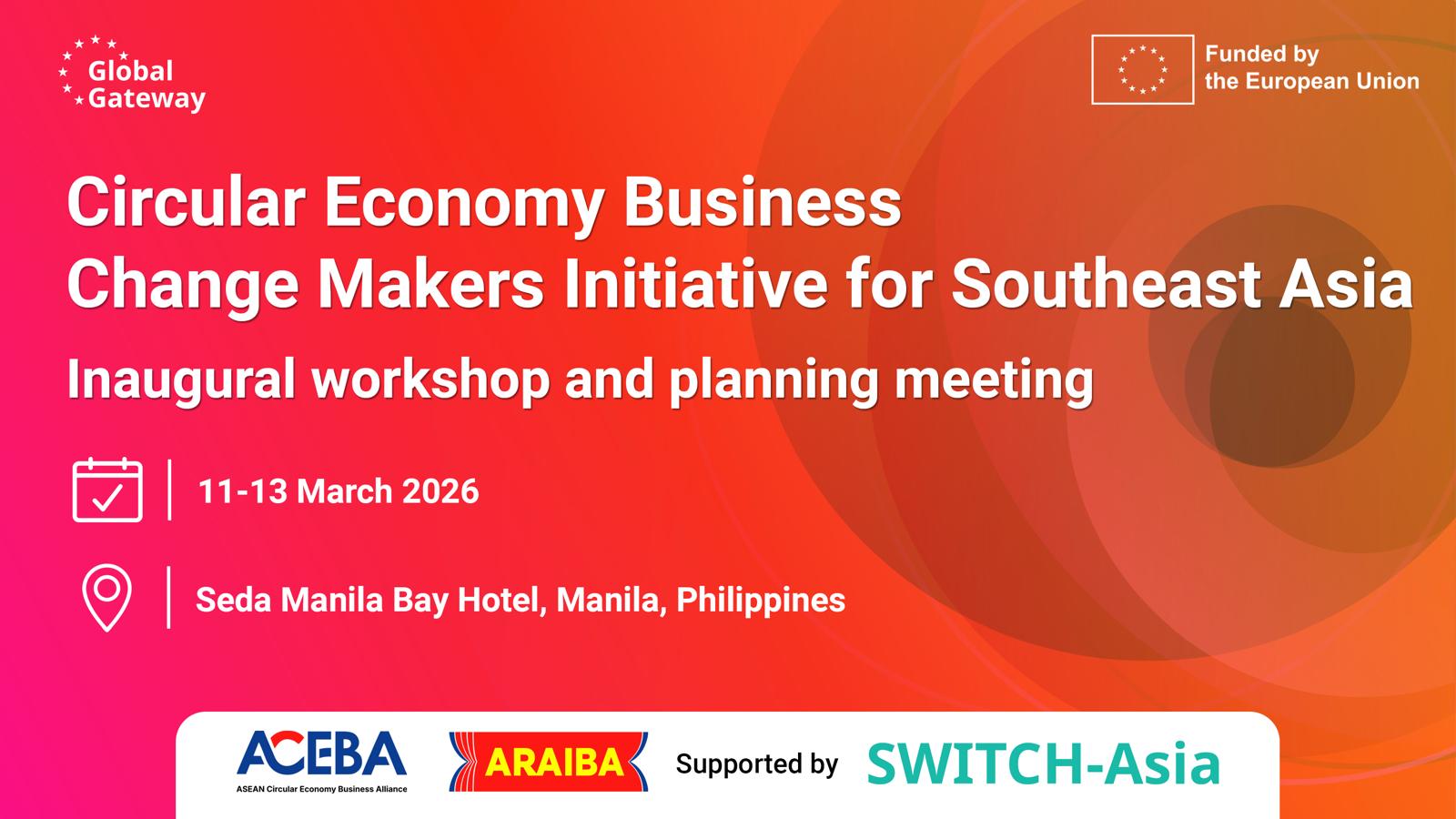
We invite interested stakeholders to submit an Expression of Interest (EoI) to participate in the upcoming Regional Workshop.
Submit your Expression of Interest HERE.
Expressions of Interest will be accepted until 26 February 2026, 12:00 noon (Bangkok time).
Background
Circular Economy is most often positioned as the opposite of the current linear take-make-use-waste economic model, to arrive at a take-make-use-recover and repeat model based on closed circular material flows where nothing goes to waste. Despite widespread appreciation for this aspirational idea, there is no widely-accepted operationalization for Circular Economy, and this feeds disinterest, inaction, and greenwashing. Even with this ongoing ambiguity, business can take responsible steps towards circularity. The number of Southeast Asian businesses acting towards the Circular Economy is on the rise, and their collective experiences demonstrate tangible business opportunities in terms of savings on materials, energy and water use and disposal costs, accessing new business and market opportunities, and getting involved in the circular, low-carbon transformation that has already started.
Southeast Asia has committed to regional Circular Economy development through the 2021 ASEAN Circular Economy Framework, and complementary national Circular Economy and related Sustainable Consumption and Production action plans, strategies, and roadmaps in majority of ASEAN Member States. Their success hinges on active contribution and innovation by businesses and other organizations to develop and implement locally appropriate circular products, services, and processes. As frontrunner companies are achieving tangible business benefits and doing good for planet and society, other companies are to follow suit, for which they need access to circular business advice and services – a niche this Circular Business Changemakers Initiative aims to fill.
A regional inaugural workshop and planning meeting is convened to kickstart the Circular Business Changemakers Initiative. The workshop aims to create a common understanding of Circular Economy, the opportunities and risks it creates for business, and practical ways ASEAN businesses can contribute. Furthermore, the workshop will co-design and plan specific business service activities to be delivered under the Changemakers Initiative. Upon completion of the workshop, it is foreseen to proceed, within 2026, with the roll out and pilot of national activities in selected ASEAN Member States, with interested and qualified workshop participants taking the lead, with the support from ACEBA and its partners.
Circular Business Changemakers Initiative
With support from the EU SWITCH-Asia programme, ACEBA is launching its circular business changemakers initiative. The initiative is addressing the need to create cadres of circular business changemakers that can support businesses in their home country to start circularizing their products, services, and operations.
Through their services, the Changemakers are expected to support businesses to map their circularity opportunities and risks, navigate circular ambitions, and develop actionable strategies, leaving space for sector and technology experts to support development and implementation of specific technical and business model solutions. The changemakers may do so through diverse service packages, including advocacy and knowledge sharing, training, mentoring, facilitation of design workshops, etc.
The initiative will kick-off with a regional workshop and planning meeting to co-design the practical modalities of ACEBA’s Changemakers Initiative with partner institutions from around ASEAN. Upon successful completion of this inaugural workshop, it is foreseen that qualified and interested participants get involved as experts, or Changemakers, in the further development and delivery of national activities in their respective home countries. Depending on the workshop outcomes, these may include:
· Design and delivery of circular economy training activities for businesses, particularly MSMEs;
· Conduct of circular design workshops, aimed at articulating and developing circular ambitions for companies and putting in place strategies for delivering these; and/or
· Practical mentoring of businesses to get them started on their circularity transition.
Inaugural Workshop and Planning Meeting
A 2.5 day regional workshop and planning meeting is being convened in Manila, Philippines on 11-13 March 2026. The two-fold objective of this meeting is:
1. To train participants on Circular Economy as a responsible business and innovation strategy, based on the business cases, business framework, and business guide developed by ACEBA; and
2. To scope standard circular business service packages, and plan the development of requisite materials and arrangements for their national roll out in participating ASEAN Member States.
Target audience/ Future National Leads. Participants in the inaugural workshop and planning meeting are expected to, in principle, be available as potential national experts for the implementation of the Changemakers Initiative in their home country this 2026.
As potential Circular Business Changemakers, participants are expected to:
1. Have completed relevant first academic degree (Bachelor or equivalent) in management, engineering, technology, and/or environment;
2. Have a minimum of five (5) years professional experience as a business mentor, trainer, and/or advisor in their home country, including a significant share thereof with MSMEs; and
3. Be associated with an established national professional institution providing business support services, in particular on innovation, change management, design, and/or sustainable development.
We invite interested stakeholders to submit an Expression of Interest (EoI) to participate in the upcoming Regional Workshop. Submit your Expression of Interest HERE.
Expressions of Interest will be accepted until 26 February 2026, 12:00 noon (Bangkok time).
Important Notice:
Please note that submission of an Expression of Interest does not constitute registration and does not imply automatic acceptance into the Regional Workshop. The organizers will review all EoIs received, and will confirm acceptance of selected applicants with a formal registration confirmation by 27 February 2026.
We encourage interested participants to submit their EoI before the deadline.
Provisional agenda
|
Wednesday, 11 March 2026 |
||
|
12:00 – 13:30 |
Registration and lunch |
|
|
Opening Session |
||
|
13:30 – 14:00 |
· Welcome by organizers and host (ACEBA, SWITCH, EUD, DENR/DTI) · Programme overview · Participants’ introductions |
|
|
Session 1: Circular Economy: exploring ambition and synergies |
||
|
14:00 – 14:20 |
What does CE mean to me? |
Icebreaker |
|
14:20 – 14:45 |
ACEBA: ASEAN Circular Economy Business Alliance · Genesis, achievements and outlook |
Presentation Q&A |
|
14:45 – 15:15 |
ASEAN Framework for Business Action on Circular Economy · CE rationale: policy objective - planetary necessity – business opportunity · CE ambition matters (guiding principles) · CE nexus agenda (sustainable resources, business responsibility, innovation, and development) |
Presentation Q&A |
|
15:15 – 15:30 |
Afternoon tea |
|
|
15:30 – 16:45 |
Country mapping and reflections · Q1: What are – key – CE in your country? · Q2: Which organizations are leading in your country on the nexus agenda items? · Q3: What are their priorities? · Q4: What are possible synergies with CE? |
· Country group discussions · Plenary report back
|
|
16:45 -17:00 |
Reflections on day 1/Outlook for day 2& 3 |
|
|
Thursday, 12 March 2026 |
||
|
Session 2: Circular Business Solutions |
||
|
08:30 – 08:40 |
Recap day 1/Overview day 2 |
|
|
08:40 – 10:30 |
CE concepts and business practices · Complementary CE perspectives and concepts · CE as an innovation agenda · CE business practices · CE solution canvas |
· Presentation · Q&A · Group assignment (CE solution canvas) · Plenary feed back |
|
10:30 – 10:45 |
Morning coffee |
|
|
10:45 – 12:15 |
Circular by design · CE business models · CE product strategies |
· Presentation · Q&A · Group assignment (CE product strategies) · Plenary feed back |
|
12:15 – 13:30 |
Lunch |
|
|
Session 3: Circular Business Transition |
||
|
13:30 – 15:15 |
Circular business transition framework · Introduction and overview SADI · Stocktake – circularity opportunity and risks · Ambition – vision and delivery pathways · Delivery – adaptation and pivoting · Integration – circular business processes |
· Presentation · Q&A · Group assignment (CE ambition development) · Plenary feed back |
|
15:15 – 15:30 |
Afternoon tea |
|
|
15:30 – 16:45 |
Circularity through markets · CE policy instruments · CE financing solutions · CE business model transformation |
· Presentation · Q&A · Group assignment (CE business model) · Plenary feed back |
|
16:45 – 17:00 |
Reflections Day 2/Outlook day 3 |
|
|
Friday, 13 March 2026 |
||
|
Session 4: Circular business champions |
||
|
08:30 – 08:45 |
Recap days 1 & 2/overview day 3 |
|
|
08:45 – 09:30 |
Circular business services provision · Information, knowledge and advocacy · Business training · Business mentoring · Design workshop |
· Presentation · Q&A |
|
09:30 – 11:00 |
Circular services delivery (country analysis) · Q1: What is already available? By whom and for whom? · Q2: What niches exist, particularly for training and design workshops? · Q3: How should these be operationalized for maximum impact? Whom to partner? Morning coffee at table |
· Country discussions |
|
11:00 – 12:00 |
Design of circular business service modules, e.g.: · Advocacy · Training · Design workshops |
· Country feed back · Group discussion to confirm design and contents for standard service modules |
|
12:00 – 13:15 |
Lunch |
|
|
13:15 – 14:15 |
Planning of next step · Country preparations and mobilization · Contents and materials development · Roles and responsibilities · Partners |
· Group discussion |
|
14:15 – 14:40 |
Reflections from participants |
|
|
14:40 – 14:45 |
Closing remarks |
|
About the ASEAN Circular Economy Business Alliance (ACEBA)
ACEBA is a business-led, ASEAN-centric initiative to foster business leadership and action on the Circular Economy, coordinated and promoted by ARAIBA Sdn Bhd, a not-for-profit business organization that works to promote and facilitate responsible business practices in ASEAN and beyond. ACEBA was launched in July 2024, with the participation of the ASEAN Secretariat, ASEAN Business Advisory Council, and the European Union Delegation to ASEAN, and operates with the technical support of the EU SWITCH-Asia Policy Support Component.
Following extensive business and stakeholders’ consultations around Southeast Asia, ACEBA developed a principles-based Circular Economy framework for business, which serves as the foundation for its advocacy, knowledge sharing, and networking activities. Moreover, ACEBA has developed over 85 Circular Economy business cases covering diverse sectors and types and sizes of business from Cambodia, Indonesia, Lao, Malaysia, Myanmar, Philippines, Thailand, and Vietnam. Their collective experiences have been transformed into a practical business guide for unlocking the circularity opportunity, which provides a flexible action menu for businesses to start, chart and implement their circularity transition.
For more information visit: www.aceba.co
Contact: [email protected]
Share: